

An app can launch on schedule and still fall short if its strategy, design, engineering, and ongoing support aren’t aligned with the business goal. Choosing a mobile app development company is about more than technical execution. It means finding a partner that can translate business objectives into a product users can rely on and the business can continue to evolve.
It’s reasonable to want clear ownership at every stage and confidence that early technical decisions won’t restrict future growth. Broad capability claims can make it difficult to distinguish a disciplined delivery approach from a polished pitch. A strong working relationship makes scope, decisions, and responsibilities clear, from defining the product through to supporting it after launch.
This guide explains what a development partner should deliver, how to assess its capabilities and working approach, and which decisions can help keep a product maintainable as user and business needs change. It also describes how Vinova brings mobile app development together with UI/UX design, custom software, and ongoing support, tailoring project work to business requirements and objectives.
Key Takeaways
- Assess a mobile app development company by how well it connects product goals with strategy, design, engineering, and ongoing support.
- Match capabilities to your requirements. A long list of technologies alone doesn’t demonstrate product fit.
- Compare delivery partners on product understanding, engineering scope, communication, ownership, and post-launch responsibilities.
- Structure the engagement around a clear progression from objectives and requirements through design, development, validation, and release preparation.
- Vinova combines mobile app development with UI/UX design, custom software, MVP development, and support, and has served more than 300 companies worldwide.
What a Mobile App Development Company Delivers Beyond Code
A mobile app development company turns product needs into software designed for mobile use. Its contribution can extend well beyond engineering: clarifying the problem, shaping user journeys, designing interfaces, connecting the app with existing systems, validating functionality, preparing for release, and supporting the product afterward. These activities are most useful when they serve a defined business case, rather than a technology choice in search of a purpose.
Definition: App delivery covers the strategy, design, engineering, integration, validation, release preparation, and support involved in creating and sustaining mobile software. The business outcomes it enables depend on how well the software addresses real user and operational needs.
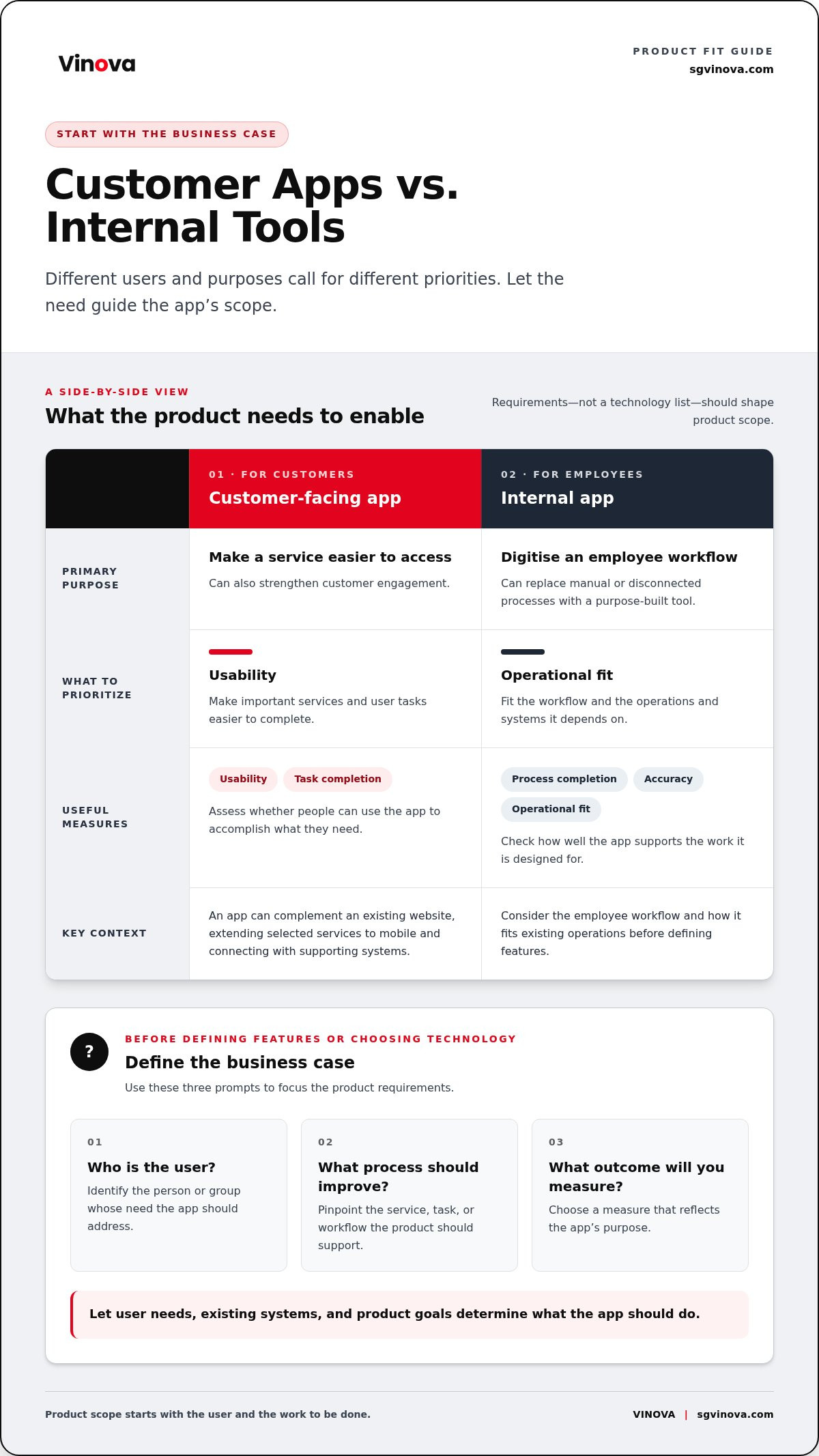
Customer-facing apps and internal tools have different purposes and measures of success. A customer app might make a service easier to access or strengthen engagement, making usability and task completion important measures. An internal app could digitise an employee workflow, where process completion, accuracy, and fit with existing operations matter more. In either case, requirements should guide the product scope.
The Mobile App Development Overview explains the broad development process and considerations involved in building for mobile platforms. For a business, the practical question is how each stage helps the app fit its users, systems, and objectives.
When does a business need a mobile app development partner?
A partner can help when mobile access would make a service more convenient, create a direct customer engagement channel, or move an operational workflow from manual or disconnected processes into a purpose-built tool. An app can also complement an existing website, extending selected services to mobile while connecting with systems that support the wider experience. Start with the business case: identify the user need, the process to improve, and the outcome to measure before defining features or choosing technology.
Which stages can a mobile app development company support?
A mobile engagement can cover a connected sequence of activities. The scope depends on project requirements, existing assets, dependencies, and stakeholder needs:
- Discovery: Clarify objectives, users, requirements, and constraints.
- UI/UX design: Structure user journeys and interfaces around the tasks people need to complete.
- Engineering: Build the mobile application and relevant integrations.
- Testing: Validate that the app behaves as intended across agreed scenarios.
- Release preparation: Coordinate the work needed to ready the product for release.
- Ongoing support: Maintain and support the product as business and user needs evolve.
These stages are not a fixed package. An engagement might focus on selected needs or connect several stages in a broader programme. Vinova brings mobile app development together with UI/UX design, maintenance, and support, tailoring project work to business requirements across the product lifecycle.
Mobile App Development Company Capabilities That Shape Product Fit
A capability list is useful only when each item connects to a business requirement. A mobile app development company might offer design, engineering, integrations, or cloud and DevOps, but the key question is how those capabilities work together for the product’s users, systems, and goals. An app that lets customers manage a service, for example, has different interface and integration needs from an internal tool that helps staff complete a recurring task.
Capability fit depends on user needs, existing systems, and product goals, not on the length of a technology list. This keeps planning focused on what the app must enable, which systems it needs to connect to, and how it may need to change over time.
- Product design translates user needs and business priorities into flows, screens, and interaction patterns.
- App engineering builds those experiences for the intended mobile platforms and product requirements.
- Backend and system integrations connect the app with relevant data, services, and business processes.
- Maintenance and infrastructure capabilities support continued operation and help inform how the product can be managed as needs evolve.
How do product design and engineering work together?
Design and engineering need to stay connected as requirements take shape. User research can show where people struggle. Interface design then makes important actions and information easier to find, while engineering determines how those interactions can work within the app and its connected systems. Accessibility, clear navigation, and straightforward task completion should guide both disciplines from the outset, not be left until the final stage.
Vinova’s UI/UX design capability complements its mobile app development work by aligning interface decisions with product requirements. When a requirement changes, considering design and engineering together helps the team assess the effects on workflows, functionality, and integration needs before settling on a solution.
How should an app fit existing platforms and future needs?
Integration planning starts by identifying where information originates, which systems the app must interact with, and how data should move between them. An app that displays account information, for instance, may depend on an existing business system. That relationship affects requirements, design, and engineering. Identifying dependencies early clarifies scope and helps prevent surprises during delivery.
Maintainability and scalability are architectural considerations, not automatic outcomes. Teams should consider how the app will be updated, how its components relate to existing platforms, and which future changes are reasonably foreseeable. Platform choices should reflect users, requirements, and the operating context. Native and cross-platform approaches involve different trade-offs, so the choice belongs in project planning rather than being driven by a default technology preference.
Vinova’s custom software, cloud and DevOps, and maintenance services can support broader product needs alongside app development, with work tailored to business requirements. Explore Vinova’s mobile app development services as part of your product planning.
How to Evaluate a Mobile App Development Company for Your Business
Choose a delivery partner by examining how it will turn product objectives into decisions, work, and clear responsibilities. A polished interface or broad technology portfolio may look persuasive, but neither proves that a team understands your users, can deliver the required scope, or will support the product after release. Compare partners against the needs of your project, using consistent criteria rather than general claims.
A practical evaluation framework should cover four areas:
- Product understanding: Can the team explain the user problem, business objective, and intended measures of success in clear terms?
- Engineering scope: Are app development, integrations, testing, release preparation, and relevant dependencies described in a way that maps to your requirements?
- Communication: Are decision-makers, review points, progress updates, and ways to resolve open issues clear?
- Post-launch responsibility: Is there a shared understanding of maintenance, support, and how future product changes will be handled?
These criteria help distinguish a proposal designed around your priorities from a generic delivery plan.
Which delivery and governance signals matter?
Look for a clearly defined scope, named decision owners, agreed review points, and a communication approach that keeps the right stakeholders informed. Transparent progress helps everyone see what is complete, which decisions remain open, and where dependencies may affect delivery. Documented decisions also reduce ambiguity as business, design, and engineering stakeholders coordinate. Vinova tailors project work to business requirements and the scope of each engagement.
Both internal and external delivery models need clear ownership. An internal team may understand organisational systems and processes, while an external company can provide development and design capabilities for a defined engagement. The business still needs internal owners for priorities, approvals, and operational context. The external partner needs to coordinate effectively with those stakeholders. Assess the model by considering access to capabilities, product knowledge, decision rights, and who will own the app after delivery.
How can a company demonstrate credibility and fit?
Evaluate portfolio evidence by looking at the problem addressed, the scope delivered, and how relevant the work is to your project. Visual polish can demonstrate design craft, but it doesn’t show by itself how a team handled system dependencies, competing requirements, or product constraints. Useful case evidence explains the challenge and the contribution made, while respecting any limits on what can be disclosed.
Credentials offer another signal, but should be interpreted precisely. Vinova holds ISO 9001:2015 and ISO 27001:2013 certifications, which relate to quality management and information security. They do not guarantee a particular app outcome. Vinova has served more than 300 companies worldwide. Consider these facts alongside the relevance of the proposed scope and the clarity of delivery responsibilities.
For a discussion grounded in your product goals, discuss your mobile app requirements with Vinova.
From Requirements to Release: How a Mobile App Engagement Progresses
A well-managed mobile app engagement connects business intent to practical decisions at every stage, from defining what the product must achieve to preparing it for release. The sequence is clear, but the work within each stage depends on scope, stakeholder input, existing systems, technical dependencies, and feedback. A mobile app development company should make those connections visible so teams know what is being decided, who needs to contribute, and what the next stage depends on.
Disciplined stages make decisions, responsibilities, and dependencies more visible. They reduce ambiguity without guaranteeing a particular outcome.
What should happen before mobile app development begins?
Define who the app is for, which business objective it supports, and what users need to accomplish. For an internal tool, this could mean documenting the steps employees follow to complete a workflow. For a customer app, it could mean identifying the service tasks users should be able to perform. Agreeing on useful measures of success gives the team a basis for prioritising requirements instead of accumulating features without a clear reason.
Before design and engineering move forward, map the relevant context:
- Users and workflows: Identify intended users, their needs, and the tasks the app must support.
- Business objectives: State the outcome the product is intended to enable and how progress will be assessed.
- Platforms and data: Identify existing systems, information sources, and dependencies that may shape the solution.
- Stakeholders and constraints: Clarify who contributes requirements or decisions and which project conditions influence scope.
Prioritised requirements connect interface decisions with engineering effort. They also give stakeholders a shared reference when feedback reveals a new need or a proposed feature affects the existing scope.
How do testing, release, and ongoing support fit together?
Once requirements and design are shaped, engineering builds the agreed functionality. Validation checks the product against those requirements, expected user workflows, and the operating environments included in the project scope. Teams can review important paths, such as signing in, completing a core task, and handling an error, to see whether the experience behaves as intended. Feedback can then guide refinements before release preparation begins.
Release preparation is a distinct phase, not simply the final coding task. It involves coordinating product and technical decisions about the release package, readiness criteria, dependencies, and responsibilities for making the app available. Details depend on the project and its intended distribution approach, so plan them rather than making assumptions.
After release, maintenance and support address the product’s continued operation and planned improvements as needs change. These activities are separate from release preparation and should be included in planning, with responsibilities matched to ongoing product requirements. Vinova’s mobile app development, maintenance, and support capabilities can be tailored to the engagement. Discuss your mobile app project with Vinova.
Why Businesses Choose Vinova as a Mobile App Development Company
Choosing a development partner means looking beyond its ability to build an app. Businesses also need a delivery scope that reflects their objectives, connects relevant capabilities, and accounts for the product’s needs after its initial release. Vinova brings mobile app development together with UI/UX design, custom software, MVP development, and maintenance and support. Project work is tailored to business requirements rather than presented as a fixed package.
This combination can suit a product that needs coordinated design and engineering, a business developing an MVP, or a team planning ongoing support. The right mix depends on the project. Some engagements may focus on the mobile app, while others may draw on additional design, software, or support capabilities to address broader requirements.
How does Vinova align capabilities with project requirements?
Project planning starts with the business context: who the app serves, what users need to accomplish, and which systems or workflows shape the solution. Those requirements guide how mobile app development connects with UI/UX design, custom software, MVP development, or maintenance and support. Vinova tailors project work to the requirements and scope of each engagement instead of assuming every business needs the same package.
This alignment gives decision-makers a practical basis for discussing priorities. A business developing an MVP can focus on the requirements for its initial scope, while a team improving an existing app can consider design, engineering, and support needs together. The aim is to connect capabilities to the work the product requires, not to add services simply because they are available.
What do Vinova’s credentials tell prospective clients?
Vinova has served more than 300 companies worldwide. This reflects the company’s stated experience across client engagements, while the relevance of that experience to a particular project depends on its requirements and scope. Vinova also holds ISO 9001:2015 and ISO 27001:2013 certifications. These relate to quality management and information security; they are not a guarantee of a specific project result.
These signals are most useful alongside a clear discussion of business objectives, delivery responsibilities, and the capabilities a project requires. The company’s stated experience, certifications, and connected service capabilities offer context for evaluating fit, but project-specific planning remains essential.
What is the next step for planning a mobile app?
Prepare a concise outline of the intended users, business goals, core workflows, and existing system dependencies. Note which outcomes matter most and where requirements remain open. This context helps frame a productive initial discussion about the product, its operating environment, and the capabilities needed to shape and deliver the work.
Learn more about mobile app development with Vinova.
Turn Your App Ambition into a Clear Next Step
Before committing to a build, turn the opportunity into a concise decision brief. Identify the business outcome that matters first, the people who will shape product decisions, and the assumptions that need to be tested. This gives your team a practical basis for prioritising work and helps a mobile app development company understand the context behind the request, not just the feature list.
Keep the brief focused instead of trying to resolve every future possibility at once. A well-framed first scope can establish a direction while leaving room to refine the product as business priorities and user needs become clearer. The most valuable early conversation connects ambition with the decisions, capabilities, and ownership needed to move forward.
Vinova can help shape that conversation around your business objectives and project requirements. Discuss your mobile app development requirements with Vinova and take the next step with a clearer foundation for planning.
Frequently Asked Questions
How much does it cost to hire a mobile app development company?
There’s no useful universal fee without defining the project requirements. Costs depend on factors such as platform scope, integrations, design needs, and support expected after release. Before comparing proposals, clarify the business objective and prioritise essential requirements. Then assess each proposed scope and delivery approach against those priorities. Vinova tailors project work to client requirements, so discuss the scope and commercial terms as part of project planning.
How long does it take to develop a mobile app?
Development timing depends on the app’s scope, integrations, platform requirements, stakeholder decisions, and validation needs. A timeframe for a different project, such as web design, won’t provide a reliable estimate for your app. Identify the essential user workflows and dependencies first, then plan the delivery stages around the work involved. Vinova tailors its engagements to project requirements, so planning should reflect the project scope rather than assume a launch date.
Can a mobile app development company work with an existing internal team?
Yes. An external partner can work alongside internal product, operations, or technology stakeholders. Internal teams can provide business context and system knowledge while the partner contributes to agreed development work. Establish who owns requirements, approvals, access to relevant systems, and feedback. Define decision rights and coordination points early so external delivery stays connected to internal priorities.
Is a mobile app development company suitable for an MVP?
Yes. A development company can help turn a focused product concept into an initial mobile application. Define the essential user workflows first, then separate capabilities needed for the initial scope from enhancements that could follow. This keeps the MVP focused while allowing the team to consider future product needs during planning. Vinova offers MVP development tailored to project requirements; an MVP doesn’t guarantee market validation or a particular business result.
What should I prepare before contacting a mobile app development company?
Prepare a brief describing the business objective, intended users, main workflows, and problem the app should address. Add known system dependencies, essential integrations, stakeholders, and project constraints. For example, note whether a workflow relies on information held in an existing business system. You don’t need a complete technical specification to begin. A clear account of priorities and open questions is enough to make the initial project discussion more focused.
Does a mobile app development company support an app after launch?
It can, depending on the project scope and agreed responsibilities. Release preparation is distinct from ongoing maintenance, which may address software upkeep and planned product improvements. Cloud and DevOps capabilities may also support broader technical operations where relevant to the project. Vinova offers maintenance and support services tailored to client requirements. Define post-launch responsibilities during project planning, without assuming a particular response time, warranty, or support package.