

An iOS app can meet its feature list and still miss the business outcome. Effective iOS app development services connect strategy, design, engineering, launch, and ongoing support to a clear delivery plan. Each stage should advance a defined business goal rather than operate as a separate workstream.
This matters when requirements are broad, enterprise systems are complex, and expectations for security, scale, and operational fit are high. Scoping only visible features can leave critical decisions about integrations, user experience, testing, and post-launch support unresolved. A clear engagement defines those boundaries early and gives stakeholders a shared basis for prioritising work.
This guide explains what a well-scoped iOS development engagement covers, how fixed-price, time-and-material, and dedicated-team models differ, and how to assess delivery capabilities against your requirements. You’ll also learn how to turn business priorities into a focused project brief, align milestones with measurable outcomes, and identify the right next step. The objective is a delivery plan that treats the app not as code alone, but as part of your wider product and business operations.
Key Takeaways
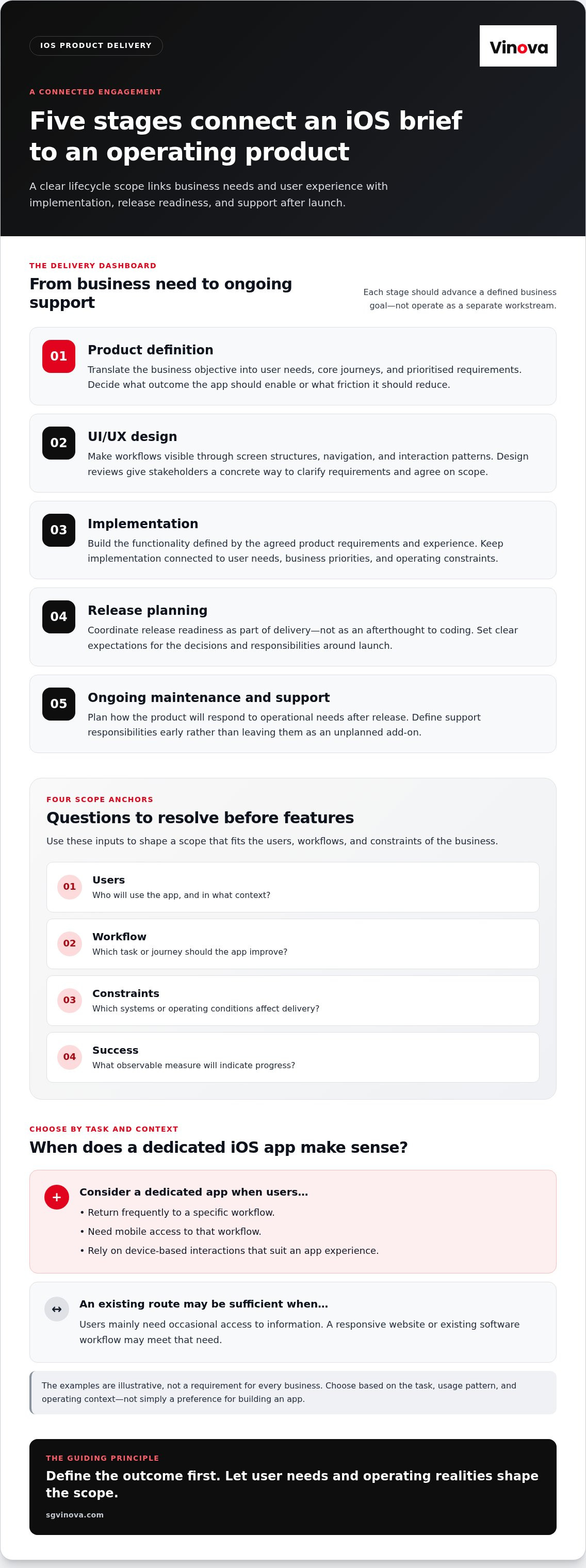
- Effective iOS app development services span product definition, UX design, implementation, release planning, and ongoing support.
- Map the app’s priority workflows to existing business systems to identify dependencies and define where custom software capabilities may be needed.
- Choose an engagement model by weighing scope clarity, internal team capacity, governance needs, and flexibility for change.
- Build a focused project brief around the business objective, user groups, key workflows, operating constraints, and success measures.
- Vinova brings mobile app development, UI/UX design, custom software, and support capabilities, and has served more than 300 companies worldwide.
Why iOS App Development Services Matter to Enterprise Products
An enterprise app should solve a defined business problem, not simply add a mobile interface to an existing process. iOS app development services bring together product definition, user experience design, implementation, release planning, and ongoing evolution. This helps decision-makers connect what teams build with how customers, employees, or operations need to work.
Effective iOS services translate clear product outcomes into a delivery scope that fits the users, workflows, and constraints of the business. That means establishing the product’s purpose before turning requests into features. A brief that starts with “we need an app” leaves core questions unanswered: who will use it, what task should become easier, and how will the organisation recognise that the change is working?
A feature checklist can grow without improving the outcome. A technology-first brief can create the same problem by selecting a platform or capability before confirming its relevance. Product definition connects user needs to business priorities, while design and engineering determine how to deliver them. iOS, the iOS operating system, may be the right environment when the intended users and workflows justify a dedicated app, but the platform alone does not establish the business case.
Start by identifying the decision the app should enable or the friction it should reduce. Then define the smallest set of user journeys that can deliver that outcome, along with the operational constraints that shape delivery. This gives stakeholders a reasoned basis for deciding what belongs in the initial scope and what can wait.
When does a business need a dedicated iOS app?
A dedicated app can make sense when users return frequently, need mobile access to a specific workflow, or rely on device-based interactions that suit an app experience. For example, an employee may need to complete field reporting away from a desktop, or a customer may need a repeat-use service workflow on an iPhone. These are illustrative cases, not a requirement for every business.
If users mainly need occasional access to information, a responsive website or existing software workflow may be sufficient. Choose based on the task, usage pattern, and operating context, not simply a preference for building an app.
What should an iOS app development engagement achieve?
An engagement should align the intended user experience with a business or operational objective that stakeholders can assess. Before defining features, clarify the primary users, their core workflows, and constraints such as existing systems, internal processes, or support responsibilities. These inputs help shape a scope that is achievable and relevant to how the organisation operates.
- Users: Who will use the app, and in what context?
- Workflow: Which task or journey should the app improve?
- Constraints: What systems or operating conditions affect delivery?
- Success: What observable measure will indicate progress?
With an agreed outcome, stakeholders can prioritise features by their contribution to the objective, manage trade-offs transparently, and avoid expanding scope just because a request is technically possible. That outcome becomes the reference point for product decisions throughout delivery.
What iOS App Development Services Cover Across the Product Lifecycle
Effective iOS app development services connect decisions made before development with the product’s operation after release. A lifecycle scope typically moves from understanding the business need and shaping the user experience to implementing agreed functionality, coordinating release readiness, and planning for maintenance and support. Defining these stages helps stakeholders understand what the engagement covers, which decisions they own, and what responsibilities continue beyond launch.
Product design determines what users need and how the experience should work; development turns that definition into a functioning app; ongoing support helps the product respond to operational needs after release. These stages are related, but they are not interchangeable. Clear boundaries reduce the risk of treating design as decoration, release as a coding task, or post-launch support as an unplanned add-on.
From product requirements to app design
Product definition translates business goals into user needs, key journeys, and prioritised requirements. If an app is intended to simplify an approval process, for example, the team needs to understand who submits a request, who reviews it, what information each role needs, and where the current process creates friction. Those answers establish the workflow before features are specified.
UI/UX design makes those workflows visible and usable. Screen structures, navigation, and interaction patterns can expose unclear requirements early, while design reviews give stakeholders a concrete basis for agreeing what belongs in scope. Vinova’s UI/UX design capabilities can inform product decisions before implementation begins, helping clarify the experience stakeholders expect.
Enterprise products may also depend on wider business systems. Custom software capabilities can address requirements that extend beyond the iOS interface, such as how information moves between an app and existing internal processes. Identify these dependencies during scoping because they can affect both the user journey and the work required to deliver it.
Development, release planning, and ongoing support
During development, the team implements the functionality established through requirements and design. Scope should make expected behaviours clear, including how users move through core workflows and what the app needs from connected systems. This gives stakeholders a practical reference for reviewing progress and assessing whether the product matches the agreed intent.
Release planning is a coordination need, not simply a final technical step. Teams may need to align app readiness with internal review, user communication, operational preparation, and decisions about how the product will be introduced. Responsibilities depend on the organisation and engagement, so define them rather than leaving them to assumption.
Launch also marks the transition into product operation. Maintenance and support can address needs that emerge after release, helping an organisation manage the app as its users, workflows, and business requirements evolve. Document which support responsibilities are included and how future changes are handled, keeping this work distinct from the initial delivery scope. This lifecycle view connects product definition, design, implementation, release coordination, and ongoing support without treating them as an undefined bundle.
Which iOS Development Engagement Model Fits Your Team?
The right engagement model depends on the shape of the work: how clearly outcomes and deliverables can be defined, how much delivery capacity exists internally, and who can make decisions as priorities change. For enterprise iOS app development services, establish these factors before agreeing how work will be governed. A suitable model makes ownership, review points, and scope boundaries explicit.
| Decision factor | Fixed-price | Time-and-material | Dedicated team |
|---|---|---|---|
| Best suited to | A defined scope with agreed deliverables and acceptance criteria. | Work where priorities or requirements may change as the product develops. | Ongoing product work that needs a consistent development team. |
| Scope and change | Changes are assessed against the agreed scope and handled through a change process. | Work can be reprioritised as needs evolve, with clear approval and tracking. | The team can work across an evolving backlog, with priorities set through regular collaboration. |
| Client involvement | Stakeholders need to provide requirements, decisions, and timely reviews. | Stakeholders need to make ongoing decisions about priorities and proposed changes. | Product ownership and regular direction are important to keep the team focused. |
| Key consideration | Unclear requirements can make a fixed scope difficult to define well. | Budget and priorities need active oversight as work progresses. | Clear ownership and a steady flow of prioritised work help the team contribute effectively. |
When is a defined project scope the better fit?
A defined scope suits a project with identified user groups, established priority workflows, and deliverables stakeholders can describe before implementation. For example, an organisation may be replacing a specific manual process with a mobile workflow whose users and required steps are already understood. This clarity supports planning, aligns stakeholders around a common target, and gives teams a consistent basis for reviewing progress against agreed outcomes.
Change control protects that focus. When a new request emerges, assess its value, impact, and relationship to the core objective before adding it to the work. This does not mean dismissing worthwhile ideas; it prevents lower-priority requests from displacing essential functionality without an explicit decision.
When should the product scope evolve during delivery?
An evolving scope is appropriate when user feedback, operational learning, or changing business priorities could influence what should be built next. Flexibility requires clear decision ownership: identify who can rank requests, resolve competing stakeholder needs, and approve scope changes. Regular reviews then turn new information into deliberate priorities instead of allowing work to expand informally.
Vinova shapes project-based development around client requirements, so the engagement scope can reflect the product’s needs and business context. For any model, document the accountable decision-makers, how progress will be reviewed, and how proposed changes affect agreed priorities. Strong boundaries create clarity without preventing adaptation.
How to Prepare a Strong Brief for iOS App Development Services
A focused brief gives stakeholders and the development team a shared basis for defining scope, evaluating trade-offs, and aligning technical decisions with business priorities. For iOS app development services, explain the problem and operating context rather than prescribing a feature list before user needs and constraints are understood. Build the brief in sequence:
- State the business objective. Describe the problem the app should address and why it matters now. Define the intended change in customer experience, employee workflow, or operational performance.
- Identify the user groups. Specify who will use the app, what they need to accomplish, and the context in which they’ll use it. Describe different roles separately if their needs vary.
- Map essential workflows. Outline the key tasks users must complete, from their starting point to the desired result. Note hand-offs, exceptions, and friction in the current process so priorities reflect real work.
- Document systems and dependencies. List existing software, data sources, and operational processes the app may need to work with. Explain what information needs to move between systems without assuming a particular technical solution.
- Separate launch priorities from later improvements. Mark capabilities that are essential to the initial release, then record enhancements that can follow. This makes trade-offs visible and helps prevent optional requests from obscuring the central outcome.
- Record constraints and success measures. Capture relevant privacy, security, accessibility, and compliance requirements, alongside operational considerations such as support ownership. Define indicators that can show whether the product is delivering value.
Define outcomes, users, and essential workflows
Make the connection between the business objective and each priority workflow explicit. For example, if the goal is to streamline an internal request process, describe who submits a request, who acts on it, what information each person needs, and what successful completion means to the organisation. Flag integration dependencies and operating conditions early so the proposed scope reflects the wider business environment, not just the app interface.
Set governance, constraints, and success measures
Name the accountable decision-maker, the people responsible for reviewing requirements, and any stakeholders whose approval is needed. This helps resolve conflicting requests and keeps scope decisions traceable. Set measures that correspond to the objective, such as completion of a priority workflow, adoption among intended users, or reduced manual handling, where those indicators suit the product and can be measured reliably.
A strong brief links requirements to outcomes without locking the team into unexamined implementation choices. Use it to align stakeholders before delivery planning begins, then refine details as requirements are assessed. Develop your iOS app brief with Vinova by bringing together business objectives, user workflows, existing systems, constraints, and success measures.
How Vinova Delivers iOS App Development Services for Business Needs
Enterprise iOS work needs to reflect the product’s purpose, its users, and the environment in which it must operate. Vinova brings mobile app development together with UI/UX design, custom software, and maintenance and support, aligning these capabilities with each project’s requirements. This creates a tailored engagement grounded in business needs, rather than treating a technology choice or feature list as the objective.
That alignment starts with a clear view of the business problem and intended outcome. A customer-facing app, an employee tool, and an operational workflow each place different demands on the product experience and surrounding systems. Defining those needs helps establish which capabilities belong in scope, where existing business software may be relevant, and how the app should support the wider product.
Align iOS delivery with product and business priorities
Mobile app development and UI/UX design address complementary parts of the product: what the app needs to do and how users will understand and complete its workflows. Connecting these requirements helps design decisions and development scope support the same business priorities. It also gives stakeholders a practical basis for reviewing proposed features, resolving competing requests, and staying focused on the app’s intended value.
Some requirements extend beyond the mobile experience. If an app depends on information or processes managed elsewhere in the organisation, related custom software capabilities can support the broader application need. Define the scope from the business requirements and existing environment rather than assuming a particular language, framework, or integration approach before those needs are understood.
Build continuity beyond the initial app release
An app’s release is a transition into ongoing product operation, not the end of its lifecycle. Vinova’s maintenance and support services can form part of that broader picture, helping organisations address product needs beyond the initial development engagement. Defining support responsibilities alongside delivery scope gives decision-makers a clearer view of how the app will be maintained as operational priorities and user needs change.
Vinova states that it has served more than 300 companies worldwide and holds ISO 9001:2015 and ISO 27001:2013 certifications. These credentials do not guarantee a specific project result; outcomes still depend on the requirements, scope, and decisions established for each engagement.
With mobile development, UX design, custom software, and support considered together, businesses can shape an iOS engagement around immediate priorities and product continuity. Discuss your iOS app objectives and scope with Vinova to define an engagement aligned with your business needs.
Turn Your iOS App Vision into a Business-Ready Plan
Move from a promising app idea to a decision-ready product direction by defining what must change for users or the organisation, identifying who will own key decisions, and setting a practical basis for assessing progress. That clarity helps your team approach iOS app development services as a strategic investment, with room to adapt as business priorities and user needs develop.
Bring your objectives, intended users, key workflows, and known constraints to a project discussion. These details provide a practical starting point for shaping a scope around your product needs. Discuss your iOS app development project with Vinova.
With a clear direction and shared ownership, your team can move forward with confidence and build toward outcomes that matter.
Frequently Asked Questions
How much do iOS app development services cost?
The cost depends on the app’s requirements, not simply the choice of iOS. A focused app with a small number of workflows has a different scope from one that needs several user roles, connections to business systems, or complex operational rules. For a meaningful estimate, define the intended users, essential features, required integrations, and launch priorities. Vinova tailors development projects to client requirements, and project pricing depends on scope.
How long does iOS app development take?
There’s no single timeline for every iOS app. Duration depends on scope, decision-making, dependencies, and review needs. A product with settled requirements and a small number of workflows differs from one that requires extensive stakeholder input or coordination with existing systems. For realistic planning, identify who approves decisions, what must be ready for launch, and which dependencies could affect progress before setting milestones.
Is iOS app development only for iPhones?
No. An iOS app can be designed for iPhone and, where product requirements call for it, iPad as well. Supporting both requires considering how the experience should adapt to different screen sizes and user contexts rather than assuming one layout fits every device. If the intended audience uses other Apple platforms, define those requirements separately so platform coverage is deliberate and reflected in the product scope.
Can an iOS app work offline?
Yes, an app can support selected functions without an internet connection if offline use is part of its requirements. For example, a field worker might need to draft a report where connectivity is unavailable, then submit it when the device reconnects. The brief should specify what information remains accessible offline, what users can change, and how updates or conflicting edits are handled after connectivity returns.
Can an iOS app connect to existing business systems?
Yes, an iOS app can be designed to exchange information with existing business systems, subject to the systems’ integration options and the organisation’s requirements. Start by documenting which records users need, where those records currently live, and whether the app must read, update, or submit them. This clarifies dependencies and helps teams plan data access, error handling, and operational ownership.
What happens if an iOS app does not pass App Store review?
If an app is rejected, review Apple’s feedback to understand which issue needs attention, then decide whether to revise the app, its metadata, or both. Address the identified concern rather than making unrelated changes. If the team believes the decision was made in error, it can use Apple’s appeal process. Allow time for review and possible revisions when planning a public release.
Does an iOS app need ongoing maintenance after launch?
Usually, yes. After release, teams may need to address defects, respond to changes in business processes, and keep the product aligned with the software and devices it depends on. Maintenance planning should identify who owns issue triage, how updates are assessed, and how proposed improvements are prioritised. Without that ownership, even a well-designed app can become harder to operate as user needs evolve.
