

Shared code is only an advantage when it supports the experience your product needs. Before choosing a cross platform app development company, determine whether one codebase can meet iOS and Android users’ expectations without creating performance or maintenance trade-offs. The right choice depends on engineering fit, not code reuse alone.
Faster delivery and a more unified build can be appealing, but they need to be balanced against platform-specific design, reliable performance and room to evolve. This guide explains how to assess whether cross-platform development suits your product, which technical trade-offs to examine, and how to evaluate a partner’s architecture and delivery approach against your business goals.
You’ll also see how design, engineering, release planning and ongoing support connect across the product lifecycle. Vinova brings mobile app development together with UI/UX design, custom software, MVP development, and maintenance and support. The aim is to help you make a grounded decision about the approach and partner that can support your product as it grows.
Key Takeaways
- Decide whether cross-platform development fits your product by weighing user expectations, performance needs, integrations and roadmap priorities.
- Assess how architecture can share application logic while preserving platform-specific experiences where they matter.
- Compare cross-platform and native development against your requirements, including code reuse, integrations and long-term maintenance.
- Evaluate a cross platform app development company by how it translates business objectives into testable requirements and connects architecture, delivery and support.
- See how coordinated mobile app development, UI/UX design, custom software, MVP development and ongoing support can align delivery with product needs.
What a Cross-Platform App Development Company Delivers
A cross-platform app development company helps plan and build applications for multiple operating systems. That work brings product decisions, design, engineering and release preparation together around defined requirements. Cross-platform development doesn’t mean every screen or function will be identical across devices. It shares selected engineering work across target platforms. How much can be reused depends on the product’s intended behaviour, supported platforms and integrations.
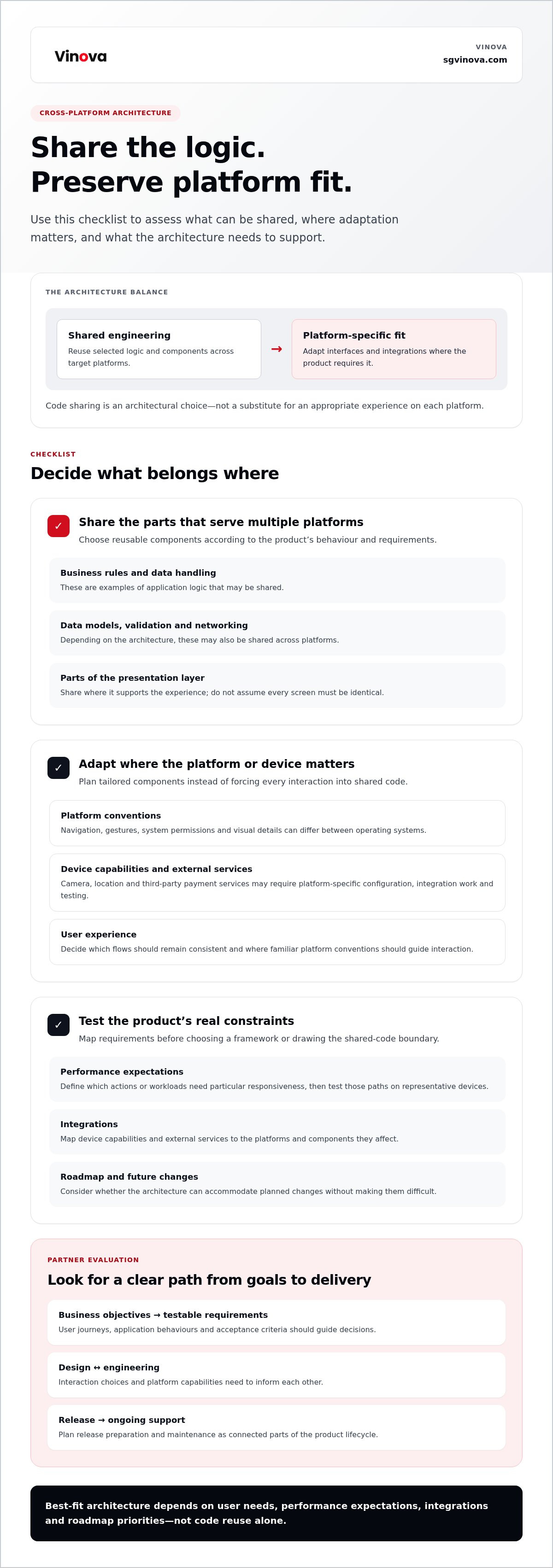
Native development, by contrast, builds an application specifically for a platform using its own development environment and conventions. A cross-platform approach may reuse application logic while still requiring platform-specific interface details or integration work. Code sharing is an architectural choice, not a substitute for delivering an appropriate experience on each platform. The Cross-platform software overview provides broader context on the approach and its frameworks.
How shared-code application development works
A shared codebase can support applications across multiple operating systems by reusing selected components, such as business rules, data handling or parts of the presentation layer. Flutter and React Native are examples of technologies used for cross-platform development. They are examples only, not an indication of the tools used on a particular project.
Reuse has limits. A product may need interface elements that follow each platform’s conventions or integrations that depend on platform-specific capabilities. Engineers can plan tailored components alongside shared logic. The practical question isn’t how much code can be shared in isolation, but whether the architecture meets user needs and accommodates integrations without making future changes difficult.
What the development partner contributes
Effective delivery starts by translating business objectives into functional and technical requirements. For example, the goal of enabling customers to complete a transaction on mobile needs to become a clear set of user journeys, application behaviours and acceptance criteria. These requirements then guide design, architecture, engineering priorities and release preparation.
UI/UX design and engineering need to inform each other. Interaction choices shape technical requirements, while platform capabilities can affect how a journey is implemented. A development partner coordinates these decisions across the product lifecycle instead of treating coding as an isolated phase.
- Requirements: Define target platforms, user needs, core functions and project boundaries.
- Design and engineering: Connect user journeys to shared and platform-specific implementation decisions.
- Release and support: Prepare the application for release, then address maintenance needs as the product evolves.
Set platform coverage, integrations and project scope according to the product’s requirements, not assumptions attached to the label “cross-platform.” Vinova can coordinate mobile app development, UI/UX design, custom software, MVP development, and maintenance and support to fit those needs. Ongoing support helps the product adapt as priorities change.
How Cross-Platform App Architecture Balances Reuse and Platform Fit
Architecture determines which parts of an application can be shared and where platform-specific implementation makes sense. Before selecting a framework, map the product’s user journeys, performance expectations, integrations and anticipated changes. A content-led service may benefit from shared business rules and data handling. A product that relies on device capabilities or highly tailored interactions may need more platform-specific components. Architectural fit depends on product requirements, not code reuse alone.
Framework selection should follow discovery. Starting with a preferred technology can constrain decisions before the team understands the experience the product must deliver. A cross platform app development company should explain how each requirement affects the boundary between shared logic and platform-specific work.
Where shared code can help, and where adaptation remains
Depending on the architecture, teams may share business rules, data models, validation, networking or parts of the presentation layer. Other components may need adaptation. Navigation patterns, gestures, system permissions and visual details can differ between operating systems. Preserving familiar platform conventions can make an app feel more natural to users, even when its underlying logic is reused.
Device capabilities and external services also shape implementation. An application using a device camera, location capability or third-party payment service, for example, may need platform-specific configuration, integration work and testing. Identify these dependencies during planning and determine how they affect scope, user experience and future changes.
- User experience: Identify which flows should remain consistent and where platform conventions should guide interaction.
- Performance: Define which user actions or workloads require particular responsiveness, then test those paths on representative devices.
- Integrations: Map device capabilities and external services to the platforms and application components they affect.
- Roadmap: Account for planned features that could change the architecture or introduce new platform-specific needs.
Architecture decisions that affect future change
A modular design can isolate platform-specific components from shared application logic, making it easier to revise one area without unnecessarily affecting others. This matters when the roadmap includes new user journeys, integrations or changes to existing services. Document key architectural boundaries and dependencies so product and engineering decisions stay aligned as requirements evolve.
Testing should reflect the intended support scope, not just the development team’s primary devices. Define which operating-system versions and device types the product must support, then plan coverage for important user flows, integration points and platform-specific behaviours. This helps surface limitations early and gives release decisions a clearer technical basis.
For a product-specific discussion of requirements, design and implementation, explore Vinova’s mobile app development capabilities.
Cross-Platform vs Native App Development: Choose by Product Requirements
Neither approach is right for every product. Base the decision on your audiences, how closely user journeys align across platforms, the application’s complexity and the capabilities on your roadmap. A product with common core workflows may benefit from shared implementation, while requirements for platform-specific behaviour or specialised device access can change the balance.
Compare the approaches against the work your product actually needs:
| Consideration | Cross-platform | Native |
|---|---|---|
| Code reuse | Can share selected application logic across platforms; the amount depends on architecture and requirements. | Typically involves separate platform-specific implementations, with less direct code sharing between them. |
| Platform-specific experience | Can support tailored interfaces, though the scope of adaptation needs to be planned. | Builds around each platform’s tools and conventions, which can suit experiences centred on platform-specific behaviour. |
| Integrations | May combine shared components with platform-specific work for device capabilities or external services. | Can implement integrations within each platform’s development environment; requirements still determine the work involved. |
| Maintenance | Shared components may simplify some changes, while platform-specific code and dependencies still require care. | Each implementation can be maintained for its platform, requiring coordination across codebases. |
This comparison is a decision aid, not a universal ranking. A consistent core journey across platforms may make shared implementation a strong candidate, but the product still needs a plan for platform conventions, integrations and testing. Separate native builds may suit specialised requirements, but they also call for deliberate architecture, coordinated release planning and ongoing maintenance. The development approach and the delivery partner’s quality are separate decisions. Either model depends on clear requirements and disciplined execution.
When a cross-platform approach may fit
Consider cross-platform development when the product targets multiple platforms and its essential journeys and business rules align. A service that lets users review information, update a profile and complete a common task, for example, may have substantial shared functionality. Confirm that reuse supports the roadmap without limiting essential platform-specific experiences, and include release coordination and maintenance in the plan.
A cross platform app development company should explain how it would preserve that shared foundation while accommodating differences that matter to users. Focus on architecture and requirements, rather than assuming one codebase removes the need for platform-aware engineering.
When native development may better match requirements
Native development may suit a product when platform-specific behaviour is central to the experience, or when specialised device capabilities and defined performance needs call for direct, platform-focused implementation. Identify which interactions, integrations or workloads call for that approach, then weigh them against the product’s audience and roadmap.
Use requirements analysis to guide the choice. Map user journeys, integration dependencies, platform expectations and future capabilities before committing to an architecture. This keeps technical decisions aligned with the product rather than general rules about either approach.
How to Evaluate a Cross-Platform App Development Company
Assess a potential partner by tracing a clear line from business objectives to engineering decisions and post-launch responsibilities. A capable cross platform app development company should make that connection visible, explain trade-offs in plain terms and define how progress will be evaluated. Use this sequence to structure your assessment:
- Test product understanding. Ask the team to summarise the business objective, target users and intended outcomes. Their interpretation should reflect your priorities, not just a feature list.
- Review requirement definition. Check how broad goals become functional requirements and testable acceptance criteria. For example, a goal to simplify account management should translate into specific user actions and expected system responses.
- Examine discovery and design. Confirm that user journeys inform UI/UX decisions and that the team can explain where platform conventions affect the experience.
- Evaluate architecture rationale. Look for a clear account of what can be shared, what needs platform-specific adaptation and why the proposed structure fits the product.
- Clarify dependencies and testing. Review how integrations, supported operating-system versions, representative devices and key user flows shape project scope and validation.
- Establish delivery and support responsibilities. Understand how release preparation, maintenance and support fit into the engagement, including how ongoing product changes will be handled.
Assess discovery, design, and technical decision-making
Strong discovery connects business goals to user journeys, then uses those journeys to guide design and technical choices. Look for a clear explanation of how shared functionality will work alongside platform-specific interaction, rather than a blanket claim that the same implementation suits every requirement. Integration planning should identify dependencies and their effect on scope. Testing expectations should show how the team will validate the features and platforms the product needs to support.
Clear reasoning matters more than technical terminology. The team should explain why an architectural decision supports the product, what trade-off it introduces and how that choice relates to planned capabilities. This gives decision-makers a basis for comparing proposals beyond delivery speed or code reuse.
Evaluate delivery continuity and organizational trust
Product delivery extends beyond release. Establish how maintenance and support align with the product’s ongoing needs, and how technical knowledge and responsibilities will carry forward as the roadmap evolves. Organizational credentials can add context to a partner assessment, but they don’t guarantee app-specific outcomes.
Vinova holds ISO 9001:2015 and ISO 27001:2013 certifications and states that it has served more than 300 companies worldwide. These are organizational trust signals, not promises of a particular project result.
Partner-fit checklist: Align product goals, explain engineering decisions, define delivery responsibilities and plan for lifecycle support. Read about Vinova’s app development services as you assess what your project requires.
Working With Vinova on Cross-Platform App Development
Choosing an approach is only part of the decision. Implementation must also fit the product’s users, technical requirements and business objectives. Vinova tailors mobile app development to project needs, bringing product priorities into discussions about scope, architecture and the experience the application should deliver. The goal is not code reuse for its own sake, but an approach that supports the required platform coverage and planned capabilities.
Align the engagement with product and business objectives
Project requirements shape both technical direction and the work needed to bring an application to market. A clear picture of target users, core journeys, integrations and future priorities helps establish which capabilities belong in the initial scope and where platform-specific considerations matter. This gives stakeholders a practical basis for weighing cross-platform development against alternatives, with decisions tied to what the product needs to do.
Design and engineering should advance together. UI/UX design can translate intended user journeys into experiences, while engineering decisions determine how those experiences are implemented across platforms. Vinova’s UI/UX design and custom software capabilities can contribute to a coordinated product scope, connecting interface decisions with the application’s underlying requirements. If a product needs an initial version to validate its direction, MVP development can also be part of the broader plan.
Planning should extend beyond initial development. Maintenance and support are relevant to sustaining an application as requirements evolve, integrations change or new priorities emerge. Including these needs in project planning helps decision-makers consider continuity alongside launch scope, rather than treating ongoing product responsibilities as an afterthought.
Move from evaluation to a project conversation
Before committing to a direction, bring the main decision criteria into one discussion: product fit, architectural rationale, delivery scope and lifecycle support. A productive conversation connects business goals to user needs, explains the reasoning behind technical choices and identifies how application requirements will inform design, engineering and ongoing care. That alignment creates a clearer basis for defining the work without assuming one approach suits every product.
Vinova serves clients worldwide and states it has served more than 300 companies worldwide. It also holds ISO 9001:2015 and ISO 27001:2013 certifications. These are organizational credentials and experience signals, not guarantees of a particular project outcome. They provide context as you consider how a development partner’s capabilities align with your product’s needs.
If you’re assessing whether a cross platform app development company can align architecture and delivery with your objectives, focus the discussion on your product goals, requirements and development needs. Discuss your mobile app development project with Vinova.
Turn Your Product Priorities Into a Clear Next Step
Translate your product ambition into a focused set of decisions: which users and outcomes matter first, what the initial release must enable, and how the application should adapt as priorities evolve. That clarity gives your team a stronger foundation for discussing scope and technical direction with a cross platform app development company, keeping investment centred on the capabilities your product needs rather than assumptions about the technology.
Bring your key user needs, business objectives and open questions into a project conversation. Vinova can use these priorities to shape a discussion about mobile app development and the support your product may need as it progresses. You don’t need every technical decision resolved before taking that step. A clear view of the problem you want to solve is a practical place to begin.
Discuss your cross-platform app development goals with Vinova and move forward with a plan grounded in your product’s direction.
Frequently Asked Questions
Can a cross-platform app connect to device-specific features?
Yes, a cross-platform app can use device-specific features when its architecture and implementation support the required access. A business app might use a camera to capture documents, for example, but the team must account for permissions, platform behaviour and error handling. Some capabilities may use framework-provided interfaces; others may require platform-specific code. Define the exact feature and expected user flow before estimating implementation and testing needs.
Is cross-platform development suitable for enterprise applications?
It can suit enterprise applications when the architecture supports the organisation’s functional, integration and operational requirements. A staff-facing app for reviewing records or submitting requests may be a candidate if its workflows and platform needs align. Assess data flows, identity and access requirements, system dependencies, and the consequences of service interruptions. A cross platform app development company should explain how its proposed design addresses these needs rather than treating enterprise suitability as automatic.
How does cross-platform app performance compare with native development?
Performance depends on the app’s workload, architecture, device range and implementation quality, so the framework label alone can’t establish how responsive it will feel. A form-based workflow has different demands from an app with intensive animation, image processing or frequent background activity. Define measurable expectations for key actions, then evaluate them on representative devices using realistic data. If a critical flow misses its target, the team can investigate that specific bottleneck.
Do cross-platform apps need separate App Store and Google Play releases?
Usually, yes. Sharing application code doesn’t eliminate the need to prepare a platform-specific app package and release submission for each store where the app will be distributed. Each release may need its own configuration, assets, version details and platform checks. Plan for separate review and release coordination, especially if both versions need to launch together. Store submission requirements and review outcomes can affect release sequencing, so don’t treat one upload as a universal launch.
Can a cross-platform app support different experiences on iOS and Android?
Yes. A shared application can make platform-specific choices, such as adapting navigation, controls or permission prompts to match expected interactions on each operating system. A settings flow might use different conventions while preserving the same underlying business rules. Decide which details should vary and which should remain consistent. Otherwise, adaptations can become inconsistent or expand without clear product value. Design reviews should assess each platform, not just a shared mock-up.
How long does cross-platform app development take?
There’s no reliable fixed duration without understanding the product scope. A focused app with a small number of journeys differs from one requiring complex integrations, multiple user roles, substantial content or extensive platform-specific behaviour. Discovery, design, testing, release preparation and feedback cycles also contribute to the schedule. For a useful estimate, define the initial release features, target platforms, external dependencies and acceptance criteria, then ask the delivery team to explain the assumptions behind its proposed plan.
Can a cross-platform app integrate with existing business systems?
Yes, it can integrate with existing systems when suitable interfaces and access are available and the architecture accounts for their requirements. A customer-facing app might retrieve account details from a company service through an API, for example. Before implementation, map the required data, system ownership, authentication approach, error handling and expected service behaviour. Legacy platforms or undocumented interfaces may need additional investigation, so include integration dependencies in scope and test successful, failed and interrupted transactions.

